
 ORDERED BY 5 PM, DELIVERED ON
  FREE POSTAGE FROM CHF 150
  LOCATION SWITZERLAND


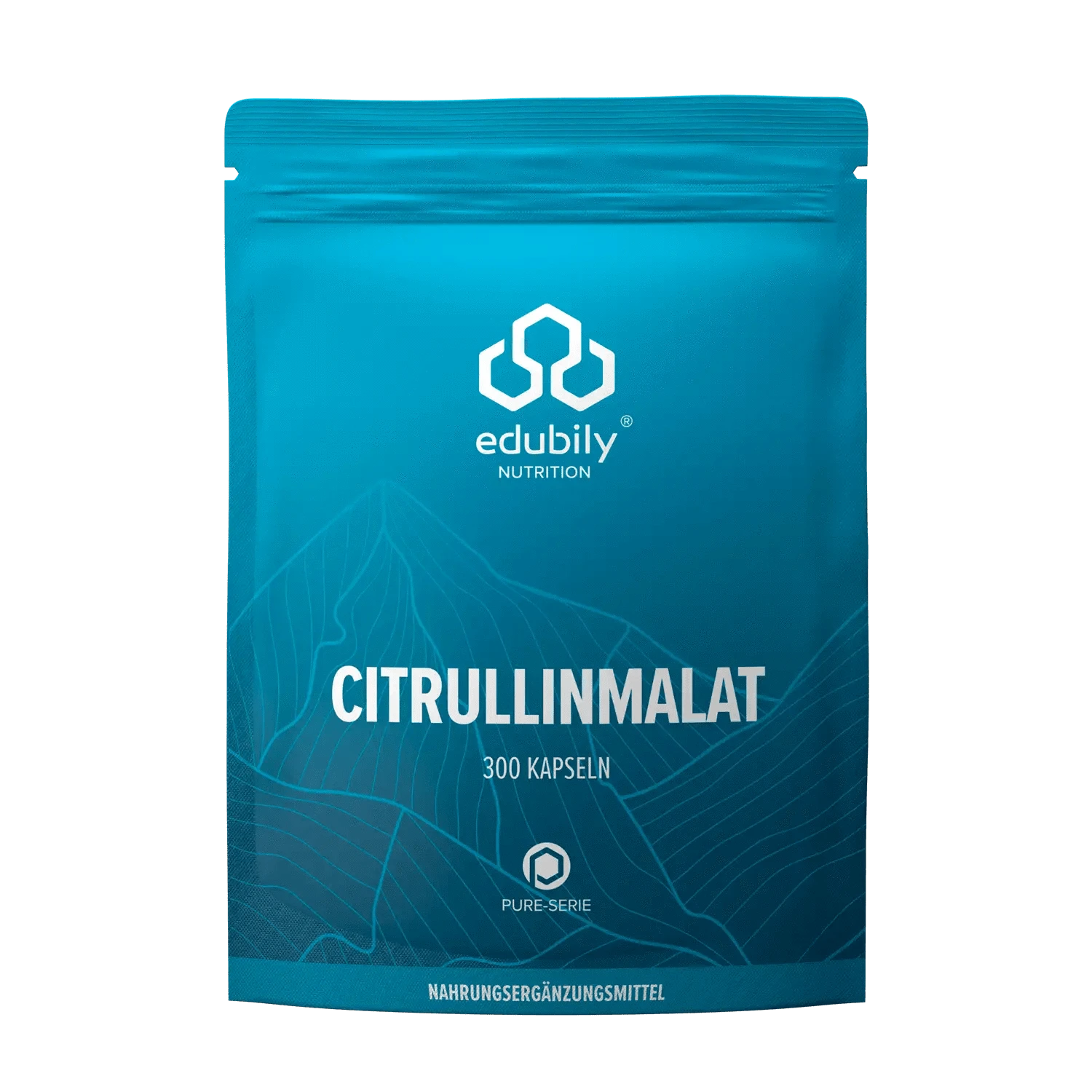


- 2.9 ga citrulline malate in practical capsule form
- Efficient increase in arginine levels
- Vegan capsules without unwanted additives
- No caffeine or DMAA
- With silica as a release agent (production-related)
- Laboratory tested for heavy metals
- Contents: 300 capsules = 60 servings
The amino acid citrulline
Citrulline is an amino acid and was first isolated from watermelons—hence its name, derived from the Latin word for watermelon, "citrullus." The scientific description of this compound dates back to Japanese researchers at the beginning of the 20th century. Watermelons are still considered a natural source of citrulline today.
In human metabolism, citrulline plays a central role in the so-called urea cycle – the biochemical process through which the body excretes excess nitrogen in the form of urea.
Citrulline is also formed as an intermediate in the formation of nitric oxide (NO) from the amino acid arginine. This process is controlled by the enzyme nitric oxide synthase. In the body, citrulline can be converted back into arginine via the urea cycle and is thus indirectly available again for NO production.
Does citrulline influence arginine levels?
Studies in animal models show that citrulline supplementation can raise blood arginine levels more effectively than the direct intake of arginine itself. The reason: Arginine is largely broken down in the intestine before it enters the bloodstream.
Citrulline, on the other hand, is largely absorbed unchanged and then converted into arginine in the body – which in turn benefits the body's own nitric oxide synthesis.
In studies with mice, citrulline supplementation achieved higher arginine availability in the blood than direct arginine intake.
"Citrulline supplementation is more effective at increasing arginine availability than arginine supplementation itself in mice."
– source
Why the combination with malate?
Citrulline malate is a special form that combines citrulline with malate—the salt form of malic acid. Malate is known from apples and also plays a role in the body's energy metabolism.
The combination of citrulline and malate was tested in a Human study, published in British Journal of Sports Medicine, was investigated. Magnetic resonance spectroscopy demonstrated that taking citrulline malate for 15 days leads to improved energy supply in the muscles.
"The rate of oxidative muscle ATP production during exercise and the rate of PCr recovery after exercise both increase in subjects receiving citrulline/malate for 15 days. This beneficial effect of citrulline/malate at the oxidative level may be mediated by malate, an intermediate of the tricarboxylic acid cycle."
Specifically, it was found that both mitochondrial ATP production during physical activity and the regeneration of phosphocreatine after exercise were increased. ATP (adenosine triphosphate) is the primary energy source for muscle contractions and physical performance.
Scientists believe that this effect is not only due to citrulline, but also to a large extent to malate.Malate is an intermediate in the citric acid cycle—a key component of aerobic energy production. There, it is converted to oxaloacetate, a key regulator of the rate of ATP synthesis under oxygen consumption.
Malate is dehydrated in the citric acid cycle to oxaloacetate, the concentration of which is one of the most important control variables for the rate of aerobic ATP production.
The combination of citrulline with malate not only improves blood circulation but also promotes ATP synthesis in the muscles.
Citrulline malate for athletes?
Citrulline malate is regularly studied in studies to enhance performance in strength and endurance sports. The results so far have been inconsistent—clear and generally applicable intake recommendations, such as those for creatine, cannot currently be derived.
Nevertheless, citrulline malate is considered a promising substance in the field of high-intensity training and competition.
Individual studies suggest that taking citrulline malate before strenuous exercise—for example, in tennis—can improve performance. It should be noted, however, that these results were obtained under controlled laboratory conditions. Whether these effects can be directly transferred to real-world competitive situations remains the subject of further research.
"These data suggest that pre-competition citrulline malate supplementation may improve the performance of tennis players. However, this study used a controlled laboratory environment, so further investigation of its direct application to on-court performance should be considered."
Frequently Asked Questions & Answers from Edubily
Who should not take citrulline?
People who have problems with the cardiovascular system or who have a disease in this area should discuss taking citrulline malate with their doctor.
People with rheumatoid arthritis may have an increased risk of developing antibodies to citrullinated proteins (ACPA), which can lead to autoimmune reactions. Likewise, people with elevated glucose levels should be cautious, as they already have elevated citrulline levels. People with low blood pressure should also avoid citrulline, as it can further lower it.
Why is there no arginine included?
Citrulline is sufficient – it is converted to arginine in the body and simultaneously inhibits arginine degradation. This keeps arginine levels high for longer than with direct arginine intake.
Why not just take arginine instead of citrulline?
Citrulline is absorbed more efficiently by the body and remains active longer. This allows it to have a more lasting effect than pure arginine.
Is the product vegan?
Yes, the PURE Citrulline Malate capsules are 100% vegan, including the HPMC capsule shell.
What are the side effects of citrulline malate?
Mild nausea may occur if taken on an empty stomach. It is recommended not to take citrulline malate on an empty stomach.
Nutritional values
| Contents | per serving (= 5 capsules) |
|---|---|
| L-Citrulline Malate | 2.9 g |
| of which L-citrulline | 2 g |
Ingredients
L-citrulline malate, hydroxypropylmethylcellulose (capsule shell), anti-caking agent silica.
Recommended intake: Take 5 capsules daily, whole or in several portions, with plenty of liquid.
Notes: Do not exceed the stated recommended daily intake. Keep out of reach of small children. This product is not a substitute for a balanced and varied diet and a healthy lifestyle. Store in a cool, dry, and dark place.

Quality & safety at the highest standard
Edubily attaches great importance to developing and manufacturing products on a scientifically sound basis. Their production is carried out by experienced partners in Germany and Austria, who are regularly inspected without notice and are certified according to IFS Food and HACCP. This means that Edubily meets strict hygiene and safety requirements. Furthermore, all products are retested in independent laboratories for factors such as heavy metals, nutrient content, and possible contaminants. Edubily's goal is not to simply offer any nutritional supplements, but rather safe and effective ones that promote health and well-being through well-thought-out formulations and continuous development. This way, fitness athletes and health-conscious individuals can be assured of receiving a high-quality and responsibly designed product.